Contrarian Take / Beginner
The Beginner Peptide Stack Everyone Recommends Is Wrong: Here Is a Smarter First Protocol
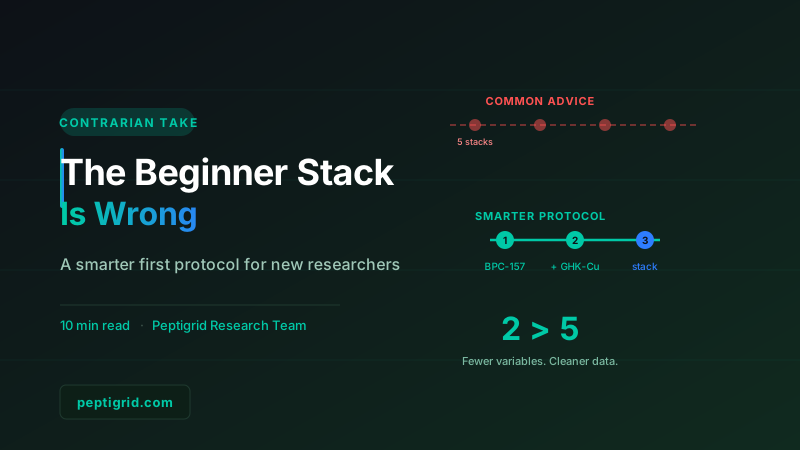
The standard advice given to first-time researchers - start with four or five peptides at once - is structurally backwards. Here is the simpler, cleaner protocol that actually lets you learn anything.
Quick Answer
For a first cycle, run two peptides on non-overlapping pathways for 8–12 weeks: BPC-157 (systemic repair) and GHK-Cu (skin, hair, connective tissue). Measure baseline endpoints, run the cycle, measure again. Beginners stacking 4 or 5 compounds cannot attribute any signal - good or bad - to any single peptide. Fewer variables, longer duration, real measurement.
What is wrong with the standard beginner stack
Walk into any peptide forum thread titled "best stack for beginners" and the recommended protocol is invariably four or five compounds at once. BPC-157, TB-500, GHK-Cu, CJC-1295, Ipamorelin, and often a sixth thrown in for fat loss or sleep. The advice is given with confidence. It is also structurally bad advice for anyone running their first cycle.
Here is the core problem. The entire purpose of a first cycle is for the researcher to learn how their body responds to a specific compound. That is the load-bearing claim of the whole exercise. If five peptides are introduced simultaneously, and the researcher feels great, they cannot say which one is responsible. If they feel terrible, they cannot say which one is the cause. If a side effect appears at week three, they cannot bisect. They have produced data with five overlapping independent variables and a sample size of one. That is not research. That is noise.
The three failure modes of multi-peptide beginner stacks
- Attribution failure. Any positive or negative signal cannot be assigned to a specific compound. The researcher learns nothing about any individual peptide.
- Side-effect ambiguity. If something feels off, the only path forward is to drop everything and restart with one variable at a time. The cycle was wasted.
- Cost compounding. Five peptides at once is expensive, both in product cost and in opportunity cost. A cleaner two-peptide cycle costs less and produces more usable data.
Stacking is a tool for researchers who already know their personal response curve to each individual compound. It is not a starting position. The order matters.
The smarter first protocol
Two peptides. Non-overlapping pathways. 8 to 12 weeks. Baseline measurement at week 0, mid-point at week 6, end at week 12.
That is the entire protocol. It is intentionally boring. It is also the version most likely to give the researcher legible, attributable, useful data on what each compound does in their specific physiology.
Why BPC-157 and GHK-Cu specifically
The pair is chosen for three reasons.
First, they sit on completely separate pathways. BPC-157 acts systemically through nitric oxide signalling and growth-factor cascades [1]. GHK-Cu acts locally through copper-dependent gene modulation in fibroblasts [2]. There is essentially no shared receptor or signalling overlap, so any signal the researcher observes can be reasonably triangulated to the compound responsible.
Second, the published safety profiles are among the cleanest in the entire research-peptide category. Neither has demonstrated significant systemic side effects in animal literature at standard research doses, and neither acts on hormonal axes (HPA, HPG, somatotropic) that beginners are not yet equipped to monitor.
Third, the endpoints are observable. Skin texture, hair density, training-recovery time, gut comfort, joint feel - these are signals the researcher can self-assess without specialised lab work. That is the right level for a first cycle.
What to measure (and when)
| Endpoint | Method | Week 0 | Week 6 | Week 12 |
|---|---|---|---|---|
| Skin texture (forearm, dominant cheek) | Photo, same lighting, same angle | ✓ | ✓ | ✓ |
| Hair density (crown / hairline) | Photo, parted same way | ✓ | ✓ | ✓ |
| Training recovery (24h DOMS, 1–10) | Self-rating after standardised session | ✓ | ✓ | ✓ |
| Gut comfort (1–10 daily average) | Self-rating, bedtime | ✓ | ✓ | ✓ |
| Joint baseline (any persistent niggle) | Pain scale, range of motion | ✓ | ✓ | ✓ |
None of this is exotic. The discipline is in actually doing it consistently, which is the part most beginners skip. Without baseline measurement, the question "did the cycle work?" has no answer.
What to deliberately skip on cycle one
- GH secretagogues (CJC-1295, Ipamorelin, MK-677, Tesamorelin). They act on a hormonal axis with feedback dynamics that benefit from prior baseline experience. Save for cycle two.
- GLP-1 agonists (Retatrutide, semaglutide-class). Categorically different pharmacology with significant systemic effects. Treat as a separate decision.
- Combination repair stacks (BPC-157 + TB-500 simultaneously). TB-500 is a perfectly reasonable peptide; running it alongside BPC-157 simply muddies the attribution. Run it on cycle two if needed.
- Cosmetic-aggressive stacks (Melanotan-class, MT-II). These have a meaningfully different risk profile and should not be mixed with a learning cycle.
What you graduate to next
Once a researcher has 12 clean weeks of BPC-157 + GHK-Cu data and a documented response profile, cycle two is where layering becomes legitimate. The most-described next step is one of the following:
- Add a GH secretagogue layer if endogenous GH-related endpoints (sleep, body composition, recovery) are the focus. Ipamorelin alone or CJC-1295 No DAC + Ipamorelin paired. See the anti-aging stack guide for the full triple-protocol structure.
- Add a tissue-specific repair layer (TB-500 alongside BPC-157) for researchers focused on specific tendon or musculoskeletal endpoints.
- Add a metabolic / mitochondrial layer (MOTS-C) for researchers focused on AMPK and metabolic endpoints. See the MOTS-C guide.
The principle stays the same at every step: add one new variable per cycle, never two. Each cycle should produce attributable signal on a specific compound or interaction.
Get started
The clean two-peptide first cycle
PEPTIGRID stocks BPC-157 and GHK-Cu from HPLC-tested vendors. Both vials include BAC water. COD available across India.
Frequently asked questions
Is it really worth running just two peptides if everyone says five?
The reason "everyone" says five is partly because it sells more product and partly because online forum culture treats stacking as a status signal. Neither of those is a methodological argument. From a research design standpoint, two non-overlapping peptides is the only first-cycle structure that produces interpretable data.
Can I add a third peptide if I "feel ready"?
The way to know you are ready for a third is to have completed a clean two-peptide cycle with documented baseline and end-of-cycle endpoints. "Feeling ready" without that data is the failure mode this entire protocol is designed to avoid.
What if I just want hair-loss results?
Then GHK-Cu alone for a 12-week cycle is the cleanest place to start. Adding BPC-157 still makes sense for general systemic repair, but a single-peptide hair-focused cycle is also defensible.
What about for a fat-loss focus?
Fat loss is a categorically different research target, generally addressed through GLP-1 agonists or GH secretagogues. Both are second-cycle territory, not first-cycle. The smarter first cycle still applies if a researcher wants to be in a clean baseline state before introducing those compounds.
Do I really need to measure?
If the researcher does not measure, they cannot tell whether the cycle worked. The entire exercise then becomes vibes. Measurement is the difference between research and roulette.
References
- Sikiric P et al. "Brain-gut Axis and Pentadecapeptide BPC 157." Curr Neuropharmacol. 2016;14(8):857-865. PubMed
- Pickart L, Margolina A. "Regenerative and Protective Actions of the GHK-Cu Peptide." Int J Mol Sci. 2018;19(7):1987. PubMed
- Pickart L et al. "GHK Peptide as a Natural Modulator of Multiple Cellular Pathways." Biomed Res Int. 2015;2015:648108. PubMed
- Sikiric P et al. "Pentadecapeptide BPC 157 and the central nervous system." Neural Regen Res. 2022;17(3):482-487. PubMed