Longevity / Sleeper Pick
The Peptide Nobody Talks About But Every Longevity Researcher Is Quietly Stacking
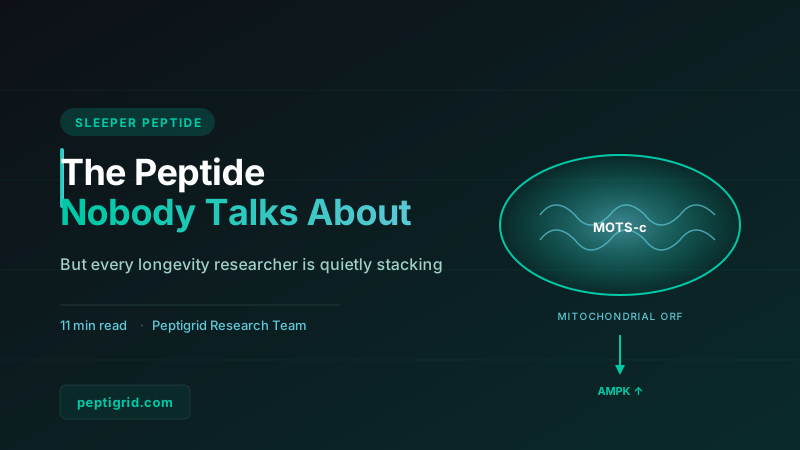
MOTS-C is encoded inside the mitochondrial genome, activates AMPK, and produces signalling that looks remarkably like exercise. It has Cell Metabolism and Nature Communications papers behind it. It also has almost no social media noise. That is exactly why serious longevity researchers add it.
Quick Answer
MOTS-C is a 16-amino-acid peptide encoded inside the mitochondrial genome (one of the only peptides we know of that is). It activates AMPK, improves insulin sensitivity in animal models, and produces molecular signatures that overlap substantially with exercise adaptation. The Lee 2015 paper in Cell Metabolism is the foundational reference. Researchers focused on metabolic and longevity endpoints quietly add it to stacks because the publication base is unusually strong for the noise level around it.
Why "the peptide nobody talks about"
The peptide world has its celebrities. BPC-157 has thousands of forum posts. Retatrutide has Reddit threads stacked many pages deep. Semaglutide owns mainstream news cycles. MOTS-C, by contrast, has a fraction of the online discussion and almost no celebrity endorsements.
What it has instead is a publication base that is structurally stronger than most of its noisier peers. The 2015 paper in Cell Metabolism, the 2021 paper in Nature Communications, and a steady stream of mechanistic studies from the Cohen lab and adjacent groups give it the kind of credibility that does not come from forum posts. It is the academic-vs-influencer divergence in microcosm.
The "quietly stacking" framing is accurate. Researchers focused on metabolic, mitochondrial and longevity endpoints add MOTS-C to protocols routinely. The cohort that tweets about peptides skips it because there is no narrative hook. The cohort that publishes on peptides reads it carefully.
A peptide encoded in mitochondrial DNA
MOTS-C is structurally unusual. Most peptides discussed in research are encoded in nuclear DNA. MOTS-C is one of the small number of peptides identified as encoded inside the mitochondrial genome itself, in the 12S rRNA gene. The acronym stands for Mitochondrial Open reading frame of the Twelve S-rRNA type-c.
This matters more than it sounds. Mitochondria are the cellular structures responsible for energy production, oxidative phosphorylation, and a long list of signals related to ageing, metabolism and disease. A peptide encoded inside the mitochondrial genome that exits the mitochondrion and signals to the nucleus represents a relatively recently described class of molecule - mitochondrial-derived peptides - and MOTS-C is the most-studied member of that class [1].
That structural backstory is part of why the longevity research community pays attention. If mitochondrial dysfunction is central to ageing (a widely-supported view), a signalling peptide encoded inside the mitochondrion that improves metabolic health is an obvious mechanistic candidate to study.
Mechanism: AMPK and the folate cycle
The most-cited mechanistic story for MOTS-C is the AMP-activated protein kinase (AMPK) pathway. AMPK is the cellular energy-sensing switch - when ATP levels drop relative to AMP, AMPK activates, triggering downstream changes that improve glucose uptake, increase mitochondrial biogenesis markers, and shift cells toward a "fasting and exercise" metabolic state.
MOTS-C activates AMPK through the folate cycle [1]. Specifically, it interferes with one-carbon transfer reactions that regulate AICAR (5-aminoimidazole-4-carboxamide ribonucleotide), an endogenous AMPK activator. Higher AICAR, more AMPK activity, and downstream signalling that mimics caloric restriction and exercise adaptation.
The evidence base
MOTS-C has a smaller but unusually high-quality publication base for a research peptide.
Lee et al. 2015, Cell Metabolism
The foundational paper. Lee and colleagues identified MOTS-C as an mtDNA-encoded peptide and characterised its metabolic effects in mouse models. Key findings: improved glucose homeostasis, reduced diet-induced and age-related obesity, and AMPK activation as the central mechanism [1]. Cell Metabolism is a tier-1 metabolic biology journal; this is not a fringe publication.
Reynolds et al. 2021, Nature Communications
Reynolds and colleagues characterised MOTS-C as an exercise-induced peptide and demonstrated that exogenous MOTS-C administration increased physical performance in aged mice [2]. The study reframed MOTS-C as an exercise-adjacent compound and is the most-cited paper for the "exercise mimetic" framing.
Centenarian correlation studies
Subsequent studies have correlated MOTS-C variants and circulating MOTS-C levels with human longevity in centenarian cohorts. The signal is suggestive but the studies are observational; correlation does not establish that exogenous MOTS-C extends human lifespan [3].
The exercise-mimetic question
The "exercise mimetic" framing is the most attention-grabbing claim about MOTS-C, and the one most often misstated. Here is the careful version.
In published animal data, MOTS-C activates many of the same molecular pathways that exercise activates: AMPK, glucose uptake, mitochondrial biogenesis markers, substrate switching toward fat oxidation. Reynolds 2021 also showed that exogenous MOTS-C improved running performance in aged mice [2]. That is real, and it is the basis for the framing.
What it does not establish: that MOTS-C is a substitute for exercise in humans. Exercise produces a much broader cascade of adaptations - cardiovascular, neurological, mechanical, hormonal, mental health - that no peptide is plausibly going to fully replicate. A more accurate description is "exercise-adjacent metabolic signalling" or "AMPK pathway support that overlaps with one component of the exercise response." Researchers thinking carefully about this distinction is one reason MOTS-C remains a sleeper rather than a hype peptide.
Dosing in published literature
| Study context | Dose | Route | Reference |
|---|---|---|---|
| Insulin sensitivity (mouse) | 0.5 mg/kg | Intraperitoneal | Lee 2015 [1] |
| Diet-induced obesity (mouse) | 0.1–0.5 mg/kg, daily | Intraperitoneal | Lee 2015 [1] |
| Exercise performance (aged mouse) | 0.5 mg/kg, 2 weeks | Intraperitoneal | Reynolds 2021 [2] |
| Self-reported research community | 5–10 mg total per administration, 2–3×/week | Subcutaneous | Community protocols (no peer-reviewed) |
The community-protocol row is conspicuously different in absolute dose because it represents per-administration totals at typical human research weights, not per-kg figures. A 70 kg human at 0.1 mg/kg would be 7 mg per dose, which is broadly consistent with the community range.
How researchers stack MOTS-C
MOTS-C does not overlap mechanistically with the standard repair, GH-axis, or GLP-1 stacks, which makes it a clean addition rather than a substitute. The most-described stacking patterns:
- With BPC-157 + GHK-Cu: Adds the metabolic and mitochondrial layer to a repair-and-cosmetic foundation. See the anti-aging stack guide.
- With Tesamorelin: For researchers focused on visceral adipose endpoints, MOTS-C complements the GHRH-driven fat-loss signal with AMPK-driven substrate switching.
- With CJC-1295 + Ipamorelin: Researchers running a GH-axis cycle add MOTS-C for the metabolic-pathway diversification.
- Alone (insulin-sensitivity-focused cycles): Single-variable cycles for researchers trying to attribute insulin-sensitivity changes specifically to MOTS-C.
Source MOTS-C
Research-grade MOTS-C with BAC water
PEPTIGRID stocks 10 mg MOTS-C from HPLC-tested vendors. COD across India. WhatsApp consultant available.
Frequently asked questions
Is MOTS-C safe?
Published animal toxicology has not raised major safety signals at standard research doses. Human safety data is limited. As with any research compound, "safe" is a clinical determination outside the scope of educational content.
How fast does MOTS-C act?
Reported onset for metabolic signals (insulin sensitivity, glucose handling) is several days to two weeks. Mitochondrial biogenesis markers in animal models shift over a 2 to 4 week window. This is not an acute, same-day signal - it is a sustained-cycle compound.
Does MOTS-C replace metformin?
Metformin and MOTS-C both activate AMPK but through different upstream pathways and with very different pharmacological profiles. They are not interchangeable. Researchers studying both frequently study them separately rather than as substitutes.
Why is it "10 mg" vials?
Because researcher per-cycle consumption at 5–10 mg per administration, 2–3 times weekly, fits cleanly into a 10 mg vial format with reasonable cycle economics. The vial sizing is a market-derived convention, not a regulatory one.
Is MOTS-C the same as "humanin"?
No. Humanin is another mitochondrial-derived peptide (the first to be discovered) with a different mechanism focused on apoptosis suppression and neuroprotection. They share the structural-class story (both encoded in the mitochondrial genome) but act differently.
References
- Lee C et al. "The mitochondrial-derived peptide MOTS-c promotes metabolic homeostasis and reduces obesity and insulin resistance." Cell Metab. 2015;21(3):443-454. PubMed
- Reynolds JC et al. "MOTS-c is an exercise-induced mitochondrial-encoded regulator of age-dependent physical decline and muscle homeostasis." Nat Commun. 2021;12(1):470. PubMed
- Fuku N et al. "The mitochondrial-derived peptide MOTS-c: a player in exceptional longevity?" Aging Cell. 2015;14(6):921-923. PubMed
- Kim KH et al. "The mitochondrial-encoded peptide MOTS-c translocates to the nucleus to regulate nuclear gene expression in response to metabolic stress." Cell Metab. 2018;28(3):516-524. PubMed
- Yen K et al. "The emerging role of the mitochondrial-derived peptide humanin in stress resistance." J Mol Endocrinol. 2013;50(1):R11-R19. PubMed